
Quote for F5 Appliance
Direct Answer
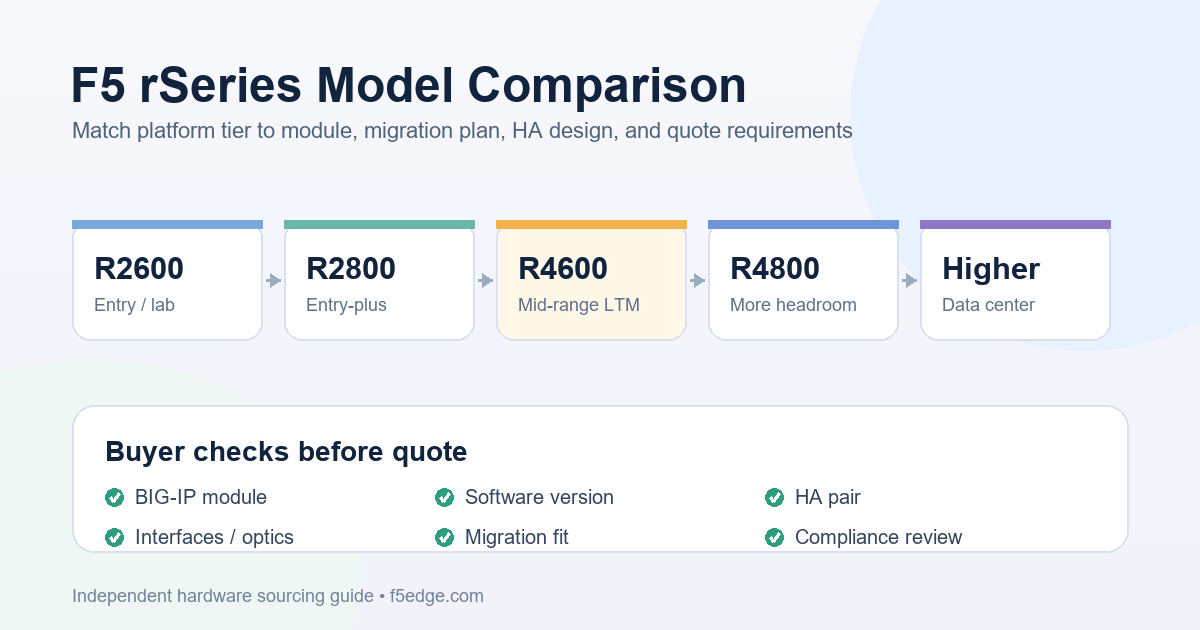
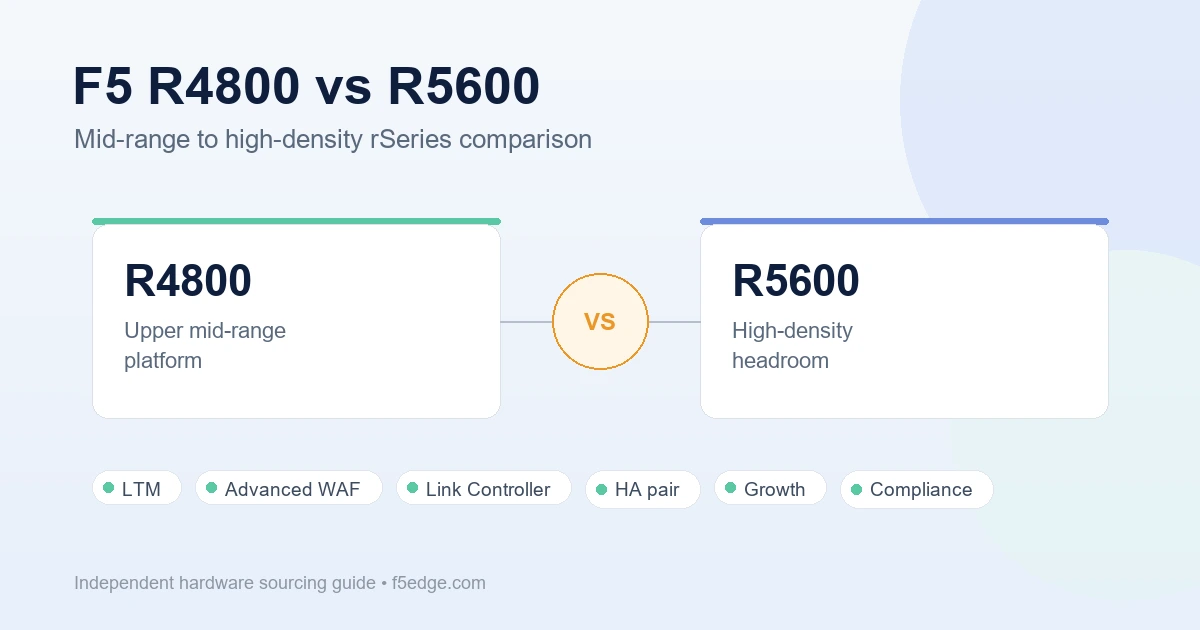
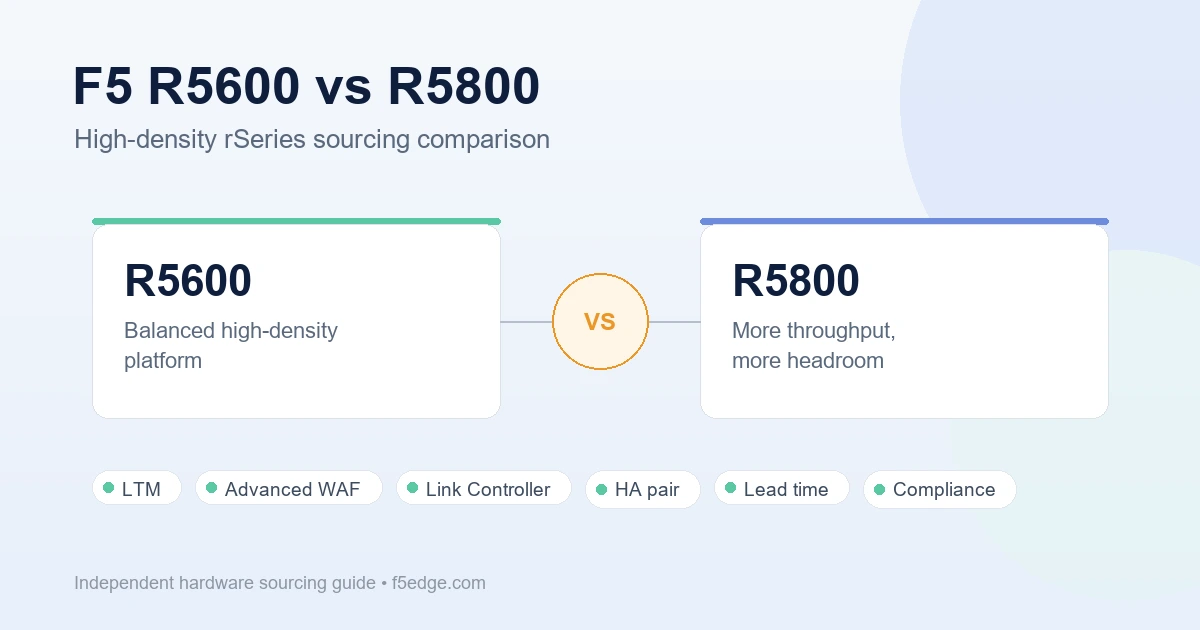
The F5 R5600 and F5 R5800 sit in the higher-density tier of the BIG-IP rSeries lineup, above the R4600/R4800 mid-range pair and below the carrier-grade R10000-class platforms. Both are used for application delivery, security, and traffic management projects that need more headroom than entry or mid-range hardware, but the right choice still depends on workload, BIG-IP modules, high availability design, budget, and lead time rather than the model number alone.
In practical buyer terms, choose the R5600 when you need strong throughput for consolidated services without paying for capacity you will not use. Choose the R5800 when you expect heavier application or security load, plan to run multiple BIG-IP modules on the same appliance, or want more lifecycle headroom before the next refresh cycle.
If you have not narrowed the platform tier yet, start with the F5 rSeries model comparison guide before comparing these two specific models.
R5600 vs R5800 Comparison Table
| Decision Area | F5 R5600 | F5 R5800 | Buyer Takeaway |
|---|---|---|---|
| Typical fit | High-density consolidation without overbuying | High-density deployments needing more headroom | Match to current and 2-3 year projected load |
| Budget profile | Reviewed when cost-per-throughput matters | Reviewed when lifecycle margin matters more than unit price | Compare total project cost, not list price alone |
| LTM use | Solid for consolidated application delivery | Better when traffic or app count keeps growing | Confirm SSL/TLS volume and HA design before sizing |
| Security use | Workable for Advanced WAF with validated policy sizing | Safer choice for heavier WAF policy sets or multi-module use | Validate policy complexity, not just unit count |
| Multi-module use | Possible but sizing should be checked carefully | More room to run LTM + WAF + LC together | Ask what else will run on the same appliance |
| HA planning | Commonly sourced as matched pairs | Also commonly sourced as matched pairs | Confirm exact matching configuration with the supplier |
When R5600 May Fit
The F5 R5600 is often a sensible choice when a project needs genuine high-density capability but the workload does not justify the largest available platform.
R5600 may fit when:
- Traffic is high but reasonably predictable, without aggressive multi-year growth assumptions.
- BIG-IP LTM is the primary module, with limited or well-sized Advanced WAF use.
- The deployment consolidates several smaller appliances into fewer, denser units.
- Budget efficiency matters as much as raw headroom.
- A matched HA pair is needed within a defined purchasing window.
When R5800 May Fit
The F5 R5800 makes more sense when the deployment needs to absorb growth, run more modules concurrently, or avoid sizing close to current utilization on day one.
R5800 may fit when:
- Production workloads are expected to grow meaningfully over the platform’s service life.
- LTM, Advanced WAF, and Link Controller (or other BIG-IP services) run together on the same hardware.
- The site is a consolidation point for multiple smaller sites or applications.
- Standardizing on a single higher platform across several locations simplifies support and sparing.
- Lifecycle flexibility outweighs minimizing acquisition cost.
As with any rSeries comparison, R5800 is not automatically the safer buy. If the extra headroom will not be used, it adds cost without solving the actual sourcing problem.
Module-by-Module Considerations
For BIG-IP LTM, compare current and projected application count, SSL/TLS volume, health monitor and iRules complexity, persistence requirements, HA design, and target software version. The R5600 is often enough for consolidated LTM-only environments, while R5800 gives more room when traffic keeps growing.
For Advanced WAF, review protected application count, request volume, policy complexity, bot or API protection scope, and logging requirements. Heavier or rapidly evolving WAF policy sets generally favor R5800-class headroom.
For Link Controller and multi-link traffic steering, confirm link count, failover design, routing dependencies, and whether the appliance also carries other BIG-IP services. Running LC alongside LTM or WAF on the same box is a common reason buyers move up from R5600 to R5800.
For Best Bundle sourcing, confirm exactly which modules are included in the license, whether it is transferable, and whether support eligibility applies. Hardware availability is independent of software entitlement.
Availability and Lead Time
At the high-density tier, configuration details matter as much as the model name: port count, optics, power supplies, and rail kits can all affect what is actually available within a given timeline. Requesting quotes for both R5600 and R5800 in parallel is a reasonable way to avoid a delay if one configuration is harder to source.
For product-specific checks, compare the F5 R5600 LTM page with the F5 R5800 LTM page, or review Advanced WAF and Link Controller variants of each model from the same product category.
Quote Information to Prepare
Before requesting a quote, prepare:
- Target model: R5600, R5800, either option, or matched HA pair
- Required BIG-IP modules: LTM, Advanced WAF, Link Controller, Best Bundle, or a combination
- Deployment role: production, HA pair, consolidation, migration staging, or disaster recovery
- Current hardware model and BIG-IP software version if replacing existing units
- Interface, optics, power, rail, and accessory requirements
- Quantity, destination country, required delivery date, and preferred condition
- Licensing, support, warranty, or license transfer expectations
- Export control or trade compliance documentation needs
Reuse the same details in the F5 BIG-IP hardware quote checklist when comparing multiple supplier responses.
Compliance Note
F5, BIG-IP, rSeries, iSeries, LTM, Advanced WAF, Link Controller, and related product names are trademarks of their respective owners. F5edge.com provides independent hardware sourcing support and does not claim to be an official or authorized F5 reseller. Quote requests are subject to export control and trade compliance review.
FAQ
Is the F5 R5800 always better than the F5 R5600?
No. The R5800 offers more headroom, but the better choice depends on workload, module mix, budget, and lifecycle planning, not the higher model number alone.
Should I request quotes for both R5600 and R5800?
Yes, if timeline matters. Comparing both models in parallel can prevent delays if one specific configuration is harder to source.
Can the R5600 or R5800 run more than one BIG-IP module at a time?
It depends on licensing and sizing. Confirm which modules are licensed on the unit and validate combined sizing before assuming multi-module use is supported.
Does a hardware quote include BIG-IP software or support?
Not automatically. Licensing, support entitlement, activation, and transfer eligibility must be verified separately from the hardware quote.