
Quote for F5 Appliance
Direct Answer
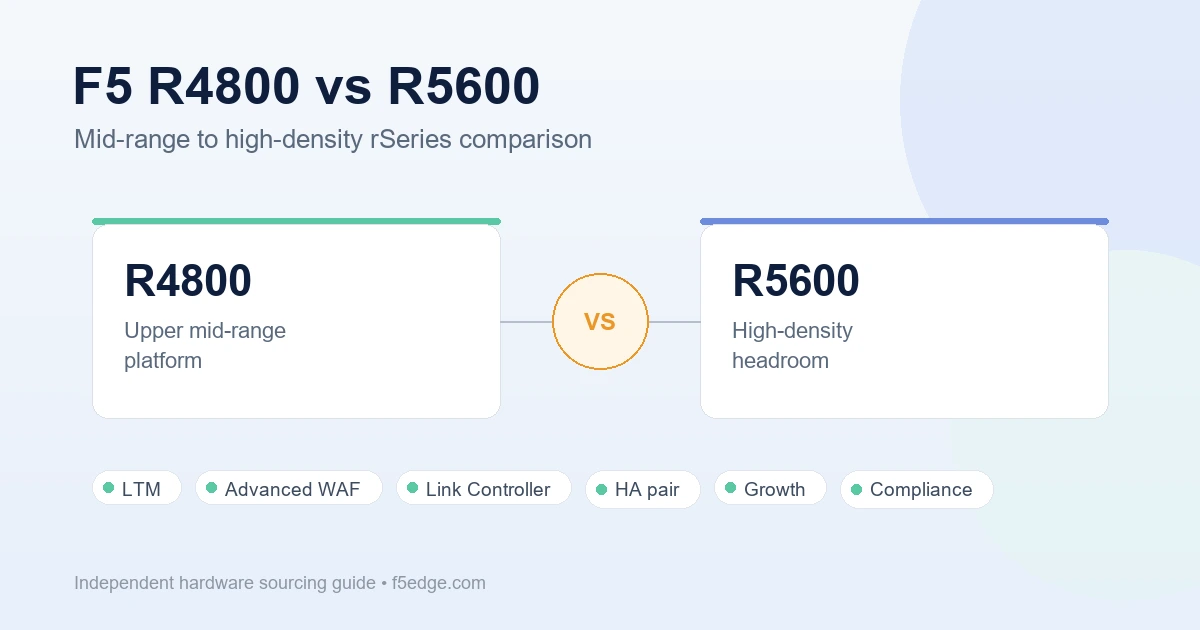
The F5 R4800 and F5 R5600 are both practical BIG-IP rSeries options for buyers who have outgrown entry-level hardware, but they fit different planning assumptions. The R4800 is usually reviewed as an upper mid-range platform for application delivery, moderate consolidation, and projects where cost control still matters. The R5600 is reviewed when the deployment needs a clear step up in density, more lifecycle headroom, or a safer margin for multi-module workloads such as LTM plus Advanced WAF.
Choose the F5 R4800 when your environment is still mainly mid-range and you want to avoid overbuying. Choose the F5 R5600 when you are consolidating more services, replacing larger legacy appliances, or planning for growth over the next refresh cycle.
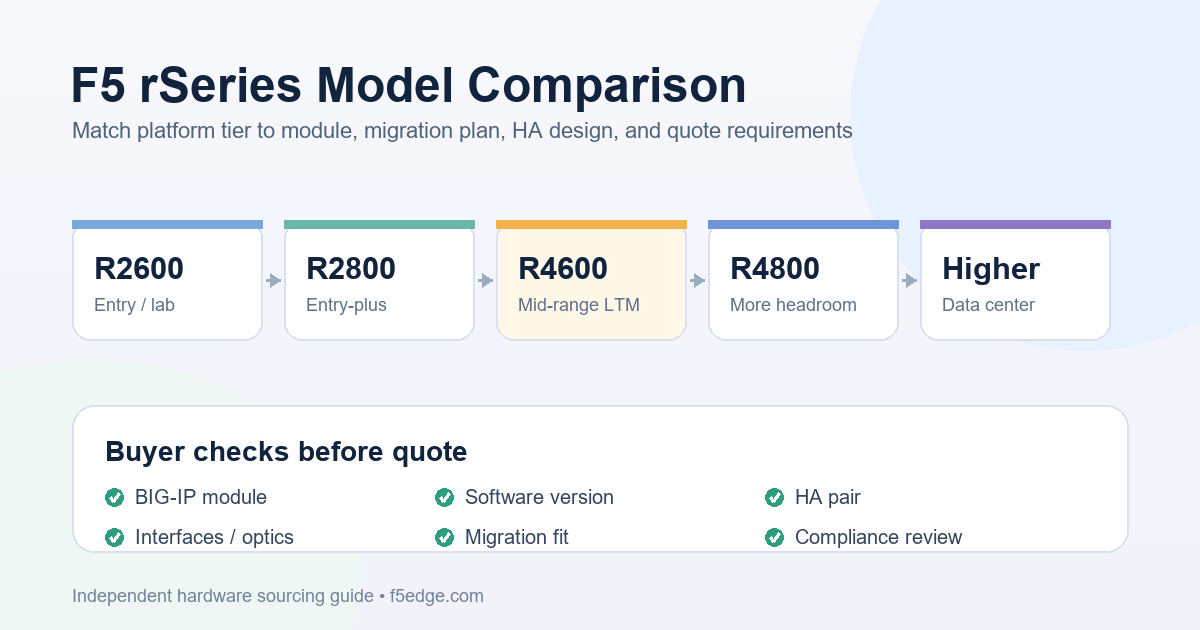
If you are still comparing the broader lineup, start with the F5 rSeries model comparison guide. If you are deciding only inside the mid-range tier, read F5 R4600 vs R4800 first.
R4800 vs R5600 Comparison Table
| Decision Area | F5 R4800 | F5 R5600 | Buyer Takeaway |
|---|---|---|---|
| Platform tier | Upper mid-range rSeries | High-density rSeries entry point | R5600 is the move-up option when R4800 feels close to capacity |
| Typical use | LTM, WAF, or LC projects with controlled growth | Consolidated services, heavier traffic, or longer headroom | Size for the real workload, not only the next model number |
| Budget profile | Often more cost-efficient when capacity needs are known | Higher project cost but more lifecycle margin | Compare unit price against refresh risk and deployment lifetime |
| LTM fit | Strong for many mid-range application delivery deployments | Better when app count, SSL/TLS load, or growth assumptions are higher | Confirm throughput, connection profile, SSL, and HA design |
| Advanced WAF fit | Works when policy count and request volume are validated | Safer for heavier WAF policy sets or mixed services | WAF sizing depends on policy complexity, not just appliance count |
| Multi-module use | Possible, but sizing should be conservative | More practical for LTM + WAF + LC consolidation | Multi-module plans often justify moving from R4800 to R5600 |
| HA planning | Common as a matched pair | Also common as a matched pair | Quote the full pair, accessories, optics, and destination together |
When the F5 R4800 May Fit
The F5 R4800 is a reasonable choice when the project needs more room than entry-level rSeries appliances but does not clearly require a high-density platform. It is often considered for refresh projects where the current workload is known, the number of applications is stable, and the buyer wants a balanced cost-to-capacity profile.
R4800 may fit when:
- BIG-IP LTM is the primary workload and traffic growth is moderate.
- Advanced WAF is required, but protected application count and request volume are already understood.
- The project is replacing smaller or mid-range BIG-IP appliances rather than consolidating many sites into one platform.
- Budget approval is sensitive to over-sizing.
- A matched HA pair is needed, but the business does not want to step into the next price tier unless there is a clear reason.
The R4800 is not the lowest-cost rSeries choice. It is the better short-list option when the R4600 is too close to the limit, but the R5600 is not yet justified.
When the F5 R5600 May Fit
The F5 R5600 becomes more attractive when the buyer wants a larger operating margin. That margin may be needed for traffic growth, additional BIG-IP modules, more demanding security inspection, or a longer service life before the next hardware refresh.
R5600 may fit when:
- Several services are being consolidated onto fewer BIG-IP appliances.
- LTM and Advanced WAF will run together and both workloads are production-critical.
- The environment has uncertain growth, seasonal peaks, or planned application expansion.
- The replacement project is moving from older high-capacity iSeries or VIPRION-era deployments.
- Standardizing on a higher-density model simplifies spares, support planning, and future expansion.
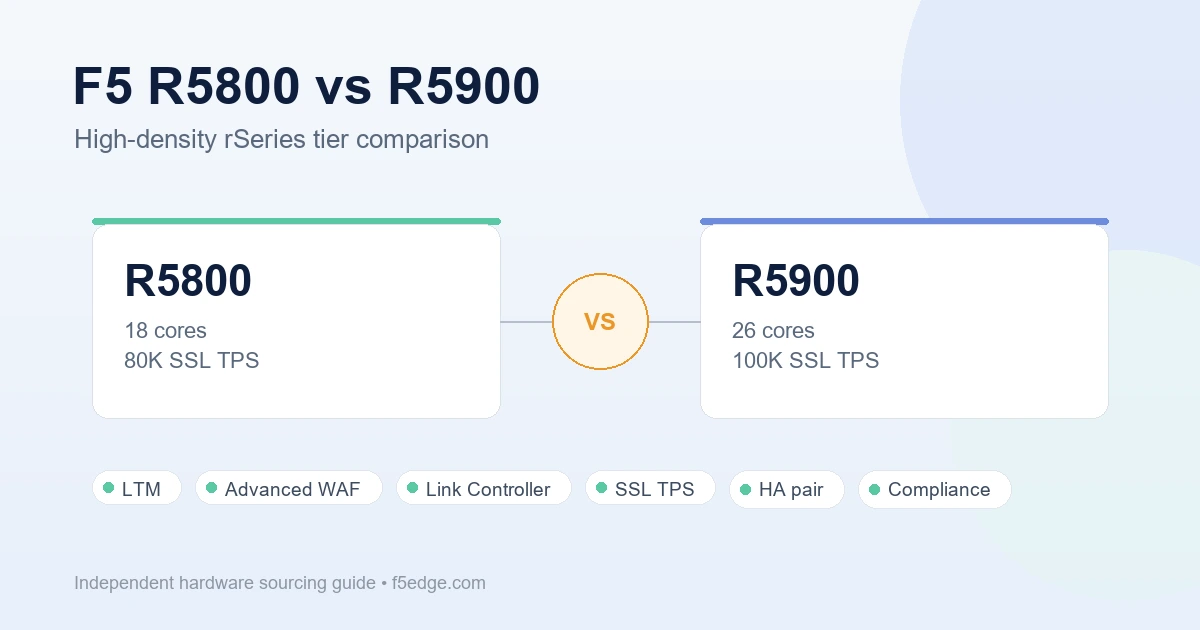
For buyers already comparing high-density platforms, the next step is to review F5 R5600 vs R5800 and decide whether R5600 is enough or whether R5800 headroom is worth the additional project cost.
Module-by-Module Considerations
For BIG-IP LTM, compare active throughput, SSL/TLS requirements, connection profile, persistence method, iRules complexity, health monitor count, and high availability mode. R4800 can be a strong fit for many LTM deployments. R5600 is more appropriate when the same environment is expected to carry more applications or higher encrypted traffic over time.
For Advanced WAF, do not size only by appliance model. Review protected application count, request volume, policy complexity, bot or API protection features, logging, and expected tuning effort. A lightly used WAF deployment may not need R5600, while a heavier WAF estate can make R4800 feel constrained.
For Link Controller, confirm link count, routing dependencies, failover behavior, DNS design, and whether LTM or WAF will share the same hardware. Running LC alone may not justify the move to R5600, but LC plus LTM plus WAF often changes the decision.
For Best Bundle sourcing, verify which modules are included, whether the license state matches the quote, and whether support or transfer eligibility is available. Hardware availability and software entitlement are separate checks.
Availability, Lead Time, and Configuration Checks
When sourcing either model, the exact configuration matters. Port options, optics, power supplies, rail kits, licensing, support expectations, and destination country can all change what is available and how quickly it can ship. A supplier may be able to quote one R4800 configuration faster than another, or offer an R5600 pair that is more practical than waiting for a specific R4800 build.
For product-specific checks, compare the F5 R4800 LTM page with the F5 R5600 LTM page. If the deployment includes security services, also check the Advanced WAF variants before finalizing the model.
Quote Information to Prepare
Before requesting a quote, prepare:
- Target model: R4800, R5600, either option, or matched HA pair
- Required BIG-IP modules: LTM, Advanced WAF, Link Controller, Best Bundle, or a combination
- Current hardware model and BIG-IP software version if this is a replacement
- Traffic profile, protected application count, SSL/TLS load, and expected growth
- Interface, optics, power, rail, and accessory requirements
- Quantity, destination country, delivery deadline, and preferred condition
- Licensing, support, warranty, or transfer expectations
- Export control or trade compliance documentation needs
Use the same details in the F5 BIG-IP hardware quote checklist so supplier responses can be compared consistently.
Compliance Note
F5, BIG-IP, rSeries, iSeries, LTM, Advanced WAF, Link Controller, and related product names are trademarks of their respective owners. F5edge.com provides independent hardware sourcing support and does not claim to be an official or authorized F5 reseller. Quote requests are subject to export control and trade compliance review.
FAQ
Is the F5 R5600 always better than the F5 R4800?
No. The R5600 offers more headroom, but the better choice depends on workload, module mix, budget, lifecycle planning, and availability.
Should I request quotes for both R4800 and R5600?
Yes, if the sizing decision is close or timeline matters. Quoting both models can reveal whether the higher platform is worth the added cost or whether the R4800 is available faster.
Can the R4800 run Advanced WAF?
It may, depending on licensing, application count, traffic volume, and policy complexity. Validate WAF sizing before assuming any model is sufficient.
When should I move from R4800 to R5600?
Move up when R4800 sizing is close to the limit, when multiple BIG-IP modules will run together, or when the project needs more lifecycle margin for growth.