
Quote for F5 Appliance
Direct Answer
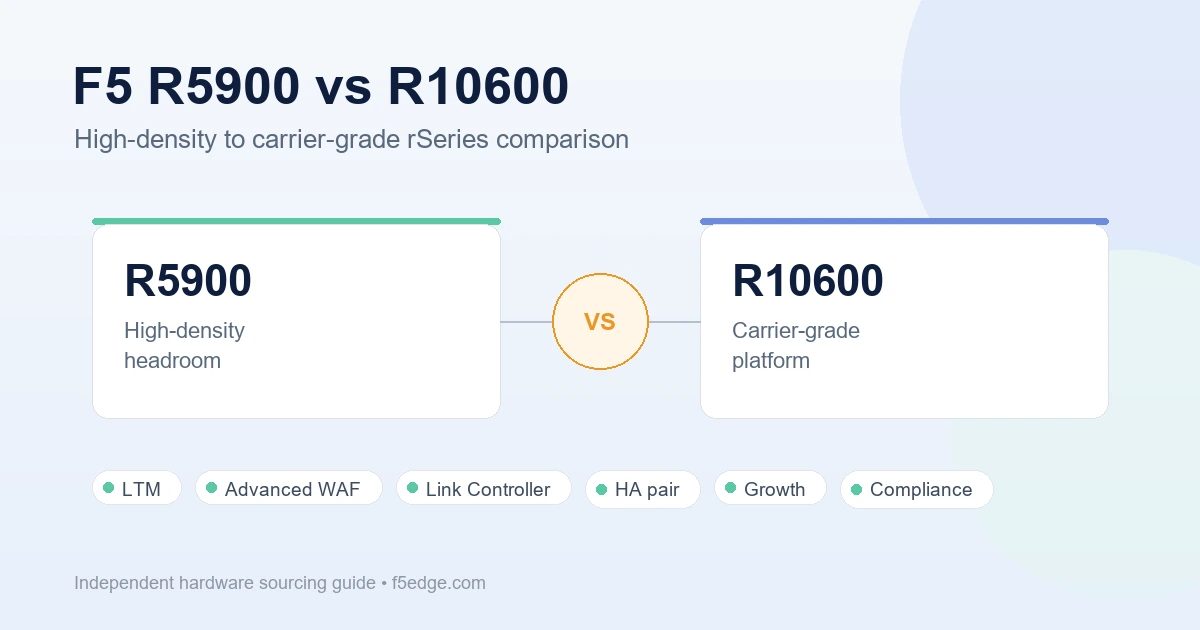
The F5 R5900 and F5 R10600 are both reviewed by buyers who need more than entry-level or mid-range BIG-IP rSeries hardware, but they are not interchangeable choices. The R5900 is typically considered when a project needs high-density application delivery, security services, and lifecycle headroom without moving into the largest platform class. The R10600 is considered when the deployment is closer to a carrier-grade, large enterprise, or major consolidation use case where capacity margin, platform standardization, and long service life matter more than minimizing the initial hardware cost.
Choose the F5 R5900 when the workload is large but still clearly within a high-density appliance plan. Choose the F5 R10600 when the environment is moving into a higher traffic tier, replacing larger legacy systems, consolidating more services, or planning for growth that makes the R5900 feel too close to the limit.
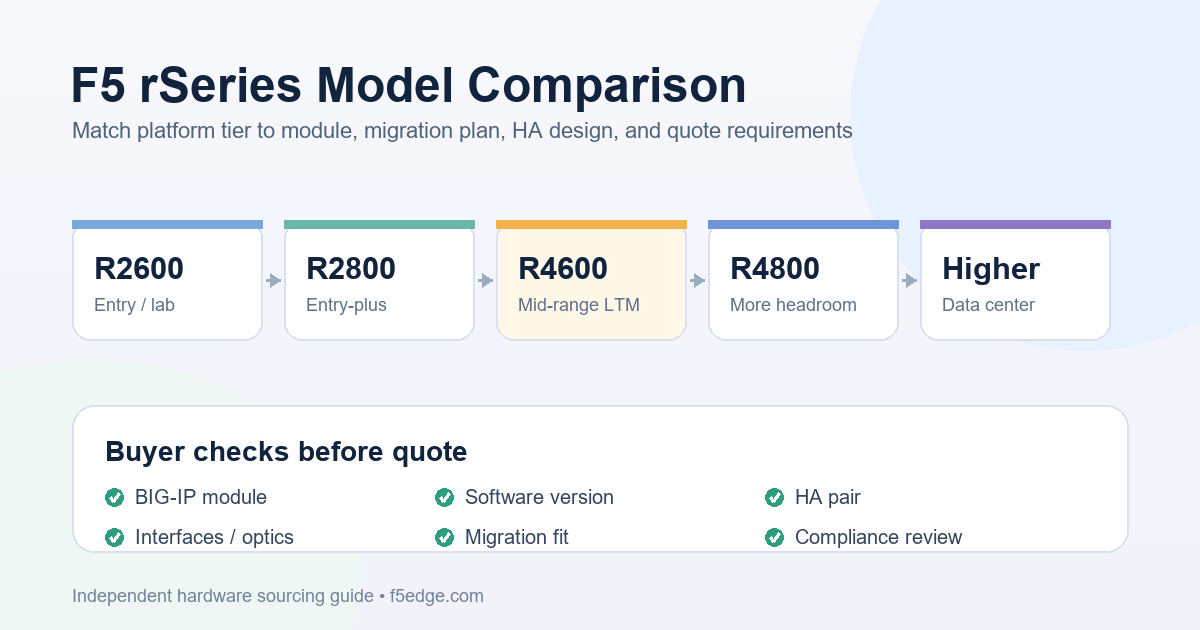
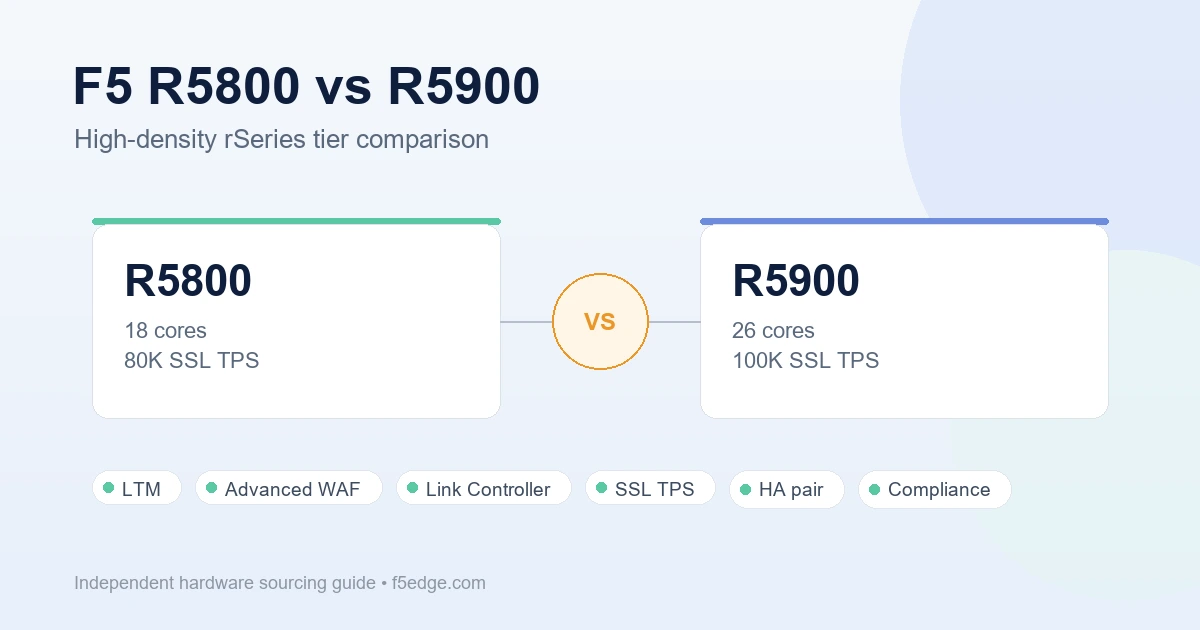
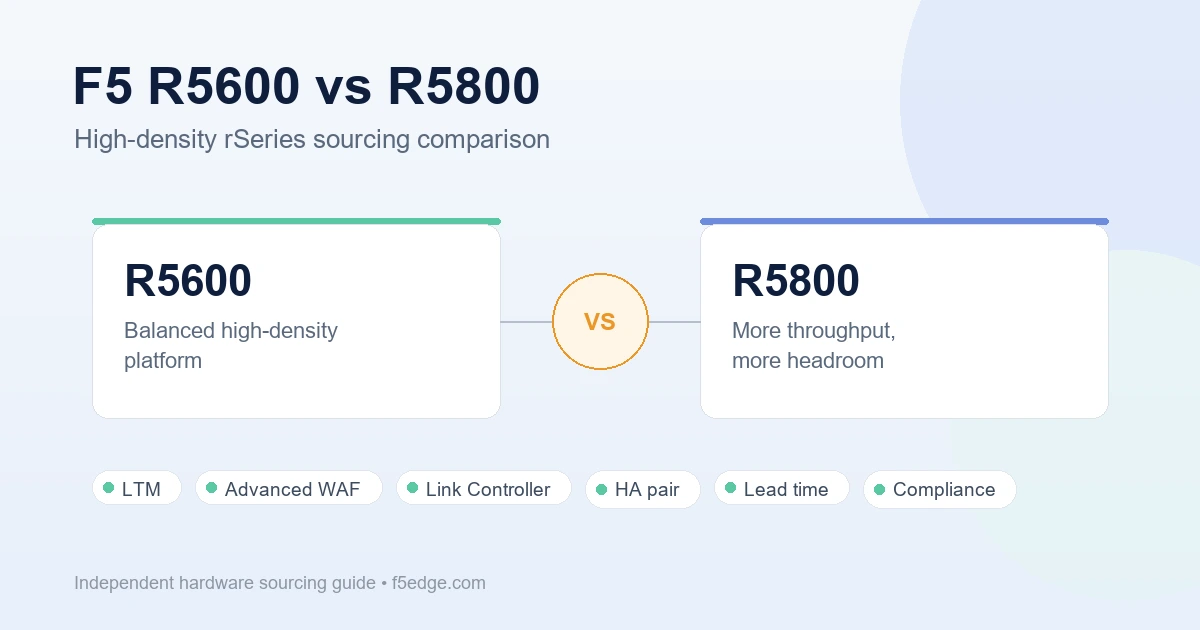
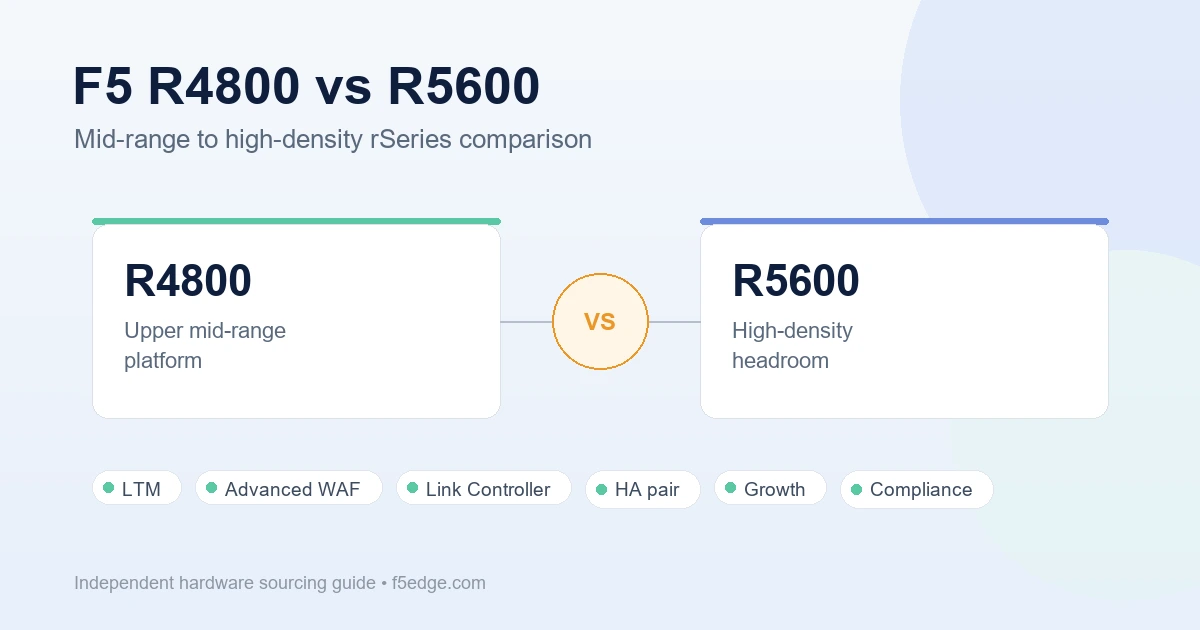
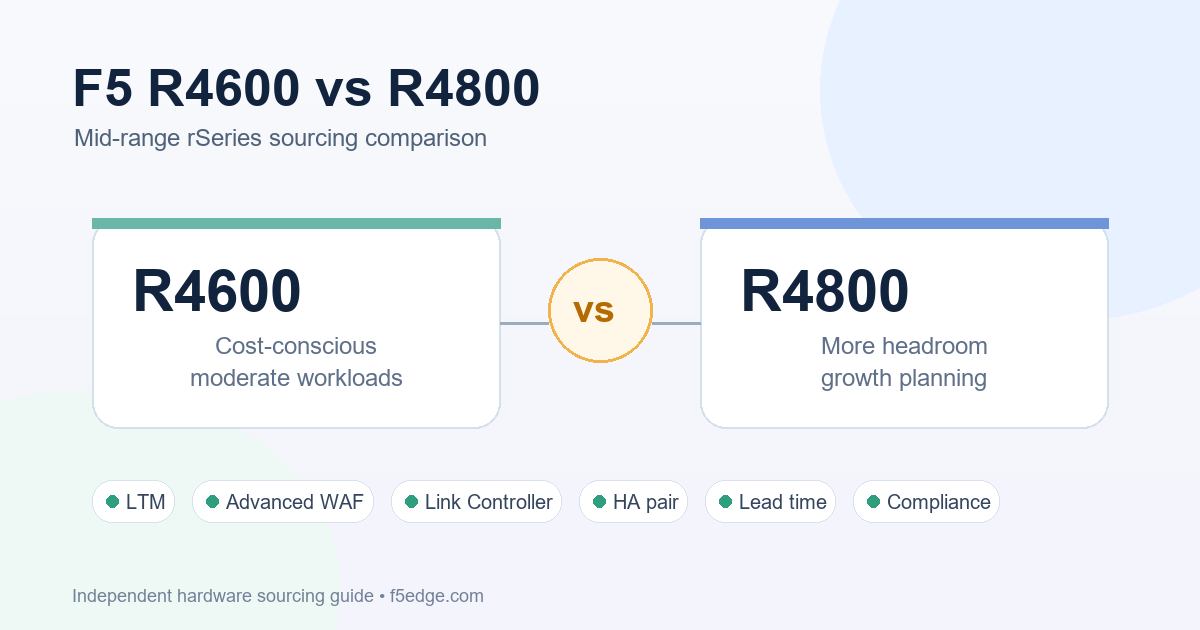
If you are still comparing earlier high-density options, review F5 R5600 vs R5800 first. For a broader lineup view, start with the F5 rSeries model comparison guide.
R5900 vs R10600 Comparison Table
| Decision Area | F5 R5900 | F5 R10600 | Buyer Takeaway |
|---|---|---|---|
| Platform role | High-density rSeries option | R10000-class carrier-grade option | R10600 is a larger platform decision, not just the next model up |
| Typical use | Large LTM, WAF, or mixed BIG-IP deployments | Major consolidation, high-growth, or service-provider-style workloads | Match the model to architecture and growth assumptions |
| Budget profile | More practical when high density is needed but budget still matters | Higher project cost but more long-term margin | Compare lifecycle risk, not only acquisition cost |
| LTM fit | Strong for many large application delivery deployments | Better when traffic, SSL/TLS, app count, or connection scale is expected to grow further | Validate throughput, SSL, connection profile, and HA design |
| Advanced WAF fit | Suitable when policy count and request volume are validated | Safer for heavier or fast-growing WAF estates | WAF sizing depends on policy complexity and logging, not model name alone |
| Multi-module use | Possible with careful sizing | More practical when LTM, Advanced WAF, and LC run together | Multi-module consolidation often justifies moving up |
| HA planning | Common as a matched pair | Common as a matched pair for larger projects | Quote the full pair, accessories, optics, licensing, and destination together |
When the F5 R5900 May Fit
The F5 R5900 is a strong candidate when the project has already outgrown mid-range rSeries models but does not clearly require a carrier-grade platform. It can be attractive for enterprise teams that want high-density capacity, a realistic lifecycle margin, and room for multiple BIG-IP services without oversizing into the R10000 class too early.
R5900 may fit when:
- BIG-IP LTM is the primary workload and application delivery requirements are large but well understood.
- Advanced WAF is required, but protected application count, policy complexity, and request volume have already been estimated.
- The project is consolidating several smaller systems, but not an entire large regional or service-provider environment.
- Budget approval is sensitive to a major platform jump.
- A matched HA pair is needed and the buyer wants strong headroom without moving to the largest available class.
The R5900 is not a low-cost appliance. Its value is strongest when the buyer needs high density and flexibility, but the R10600 would add capacity that is unlikely to be used during the planned service life.
When the F5 R10600 May Fit
The F5 R10600 becomes more relevant when the deployment assumptions change from “large enterprise appliance” to “strategic platform.” That may mean higher traffic growth, more encrypted traffic, heavier security inspection, more applications, a larger consolidation scope, or longer refresh-cycle planning.
R10600 may fit when:
- The environment is consolidating many services, applications, or sites onto fewer BIG-IP platforms.
- LTM, Advanced WAF, Link Controller, and related BIG-IP services may run together in production.
- Traffic growth is uncertain, seasonal peaks are large, or the project needs more room for future application expansion.
- The replacement project is moving from larger iSeries, VIPRION-era, or other high-capacity deployments.
- Standardizing on a larger platform simplifies spares, operations, and long-term support planning.
For buyers already considering R10000-class appliances, the next comparison is usually between R10600, R10800, and R10900. In that case, the decision is less about whether to move up from R5900 and more about how much capacity margin the R10000 deployment should include.
Module-by-Module Considerations
For BIG-IP LTM, compare current and projected application count, SSL/TLS requirements, connection behavior, persistence design, iRules complexity, health monitor count, and high availability architecture. R5900 can be a strong LTM option for many large enterprise projects. R10600 is more appropriate when the same environment is expected to carry more applications, more encrypted traffic, or a larger consolidation role over time.
For Advanced WAF, do not size only by appliance model. Review protected application count, request volume, policy complexity, bot or API protection scope, logging volume, and expected tuning effort. A well-sized WAF deployment may fit R5900, while a heavier or fast-growing WAF estate can justify the R10600.
For Link Controller, confirm link count, routing dependencies, failover behavior, DNS design, and whether LTM or WAF will share the same hardware. LC by itself may not require a move to R10600, but LC plus LTM plus Advanced WAF can change the sizing decision.
For Best Bundle or multi-module sourcing, verify exactly which modules are licensed, whether the license state matches the quote, and whether support or transfer eligibility is available. Hardware availability and software entitlement are separate checks.
Availability, Lead Time, and Configuration Checks
At this tier, the exact configuration matters. Port options, optics, power supplies, rail kits, licensing, software expectations, support status, and destination country can all change availability and lead time. A supplier may be able to quote an R5900 pair quickly while a specific R10600 configuration takes longer, or the reverse may be true depending on inventory.
For product-specific checks, compare the F5 R5900 LTM page with the F5 R10600 LTM page. If the deployment includes security services, also check Advanced WAF variants before finalizing the model.
Quote Information to Prepare
Before requesting a quote, prepare:
- Target model: R5900, R10600, either option, or matched HA pair
- Required BIG-IP modules: LTM, Advanced WAF, Link Controller, Best Bundle, or a combination
- Current hardware model and BIG-IP software version if this is a replacement
- Traffic profile, SSL/TLS load, protected application count, and expected growth
- Interface, optics, power, rail, and accessory requirements
- Quantity, destination country, delivery deadline, and preferred condition
- Licensing, support, warranty, or transfer expectations
- Export control or trade compliance documentation needs
Use the same details in the F5 BIG-IP hardware quote checklist so supplier responses can be compared consistently.
Compliance Note
F5, BIG-IP, rSeries, iSeries, LTM, Advanced WAF, Link Controller, and related product names are trademarks of their respective owners. F5edge.com provides independent hardware sourcing support and does not claim to be an official or authorized F5 reseller. Quote requests are subject to export control and trade compliance review. We do not process requests involving restricted destinations, prohibited parties, or prohibited end uses.
FAQ
Is the F5 R10600 always better than the F5 R5900?
No. The R10600 offers a larger platform class, but the better choice depends on workload, growth assumptions, module mix, budget, availability, and lifecycle planning.
Should I request quotes for both R5900 and R10600?
Yes, if the sizing decision is close or the delivery timeline matters. Quoting both models can show whether the R10600 headroom is worth the added project cost or whether the R5900 is available faster.
Can the R5900 run Advanced WAF?
It may, depending on licensing, application count, request volume, policy complexity, and logging requirements. Validate WAF sizing before assuming any model is sufficient.
When should I move from R5900 to R10600?
Move up when R5900 sizing is close to the limit, when multiple BIG-IP modules will run together, when the deployment is a major consolidation point, or when the project needs more lifecycle margin for growth.