
Quote for F5 Appliance
Direct Answer
The F5 R12600-DS, R12800-DS, and R12900-DS sit at the top of the BIG-IP rSeries lineup, and all three ship only as Best Bundle appliances rather than as separate LTM-only, Advanced WAF-only, or Link Controller-only hardware. That is a meaningful difference from the R2000 through R10000 tiers, where each model has independent single-module SKUs. If a project has reached the R12000-DS class, the sourcing decision is no longer “which module do I need” — it is “how much consolidated service density and vCMP tenant capacity does this platform need to carry.”
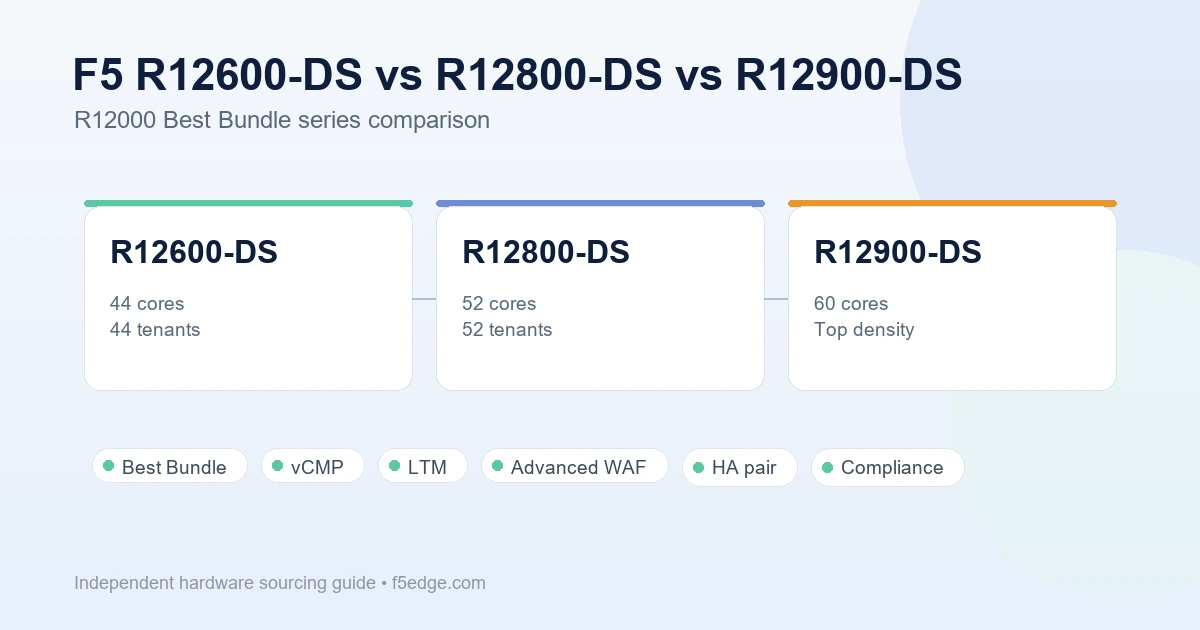
Across the three models, chassis-level throughput and port configuration are shared, but service-processing capacity scales up the ladder: the R12600-DS carries 44 service cores and supports up to 44 vCMP tenants, the R12800-DS steps up to 52 cores and 52 tenants with a balanced L4/L7 throughput profile, and the R12900-DS is the top model with 60 cores and the highest tenant density of the three. Choose based on how many services, tenants, or business units the platform needs to consolidate — not on ticket price alone.
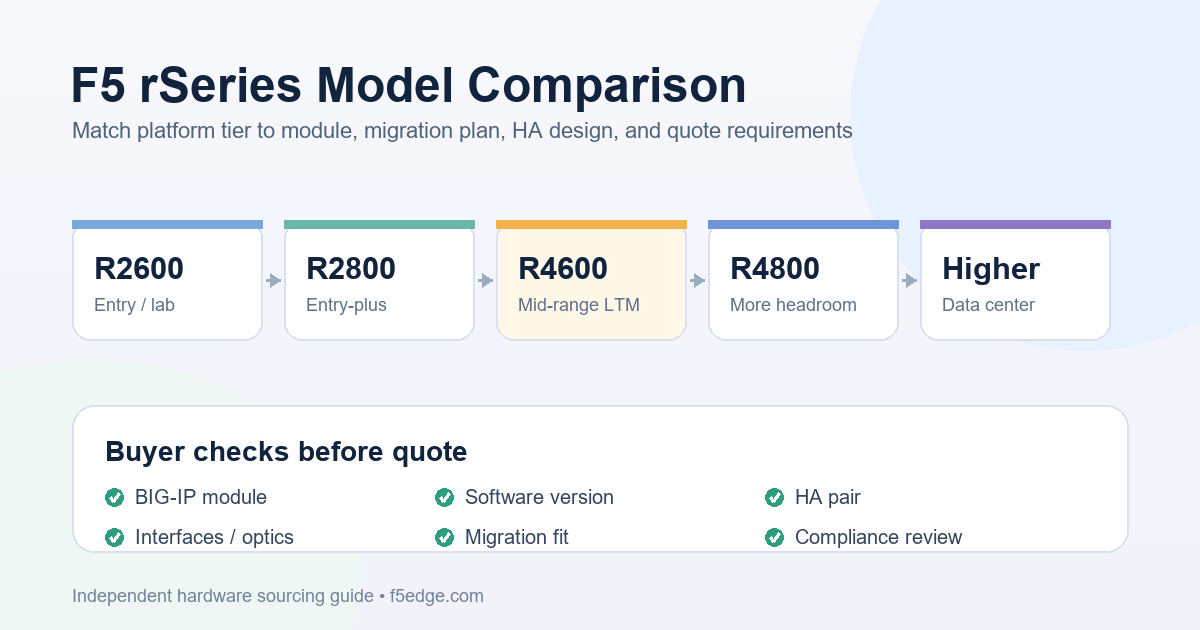
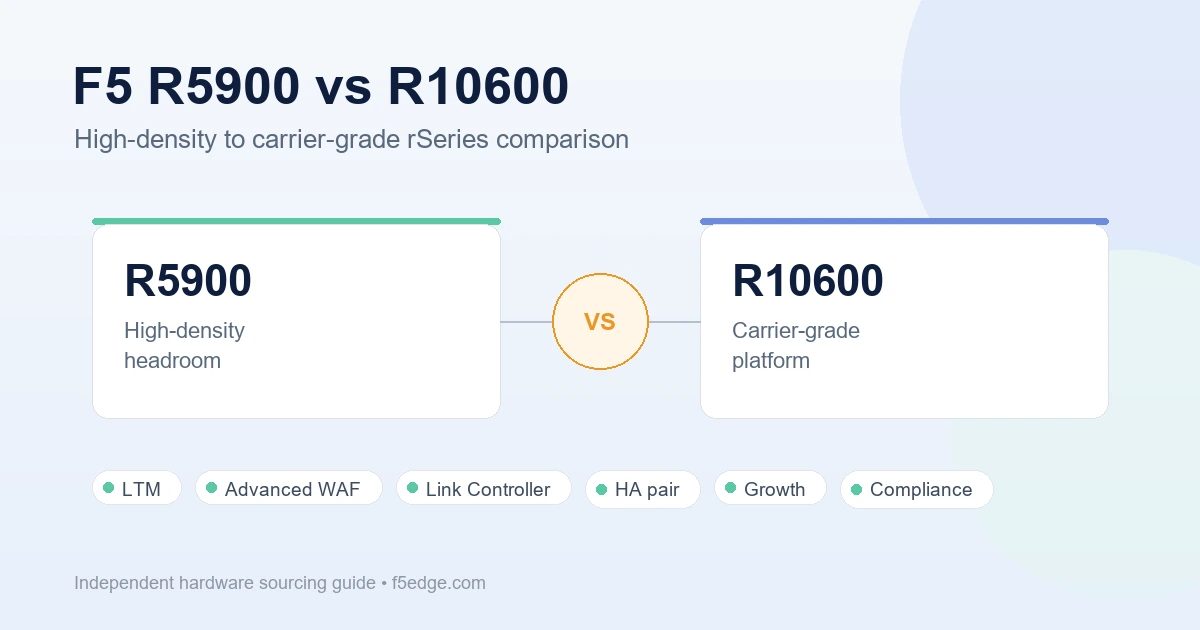
For the tier below this, review F5 R5900 vs R10600. For the full lineup, start with the F5 rSeries model comparison guide.
R12600-DS vs R12800-DS vs R12900-DS Comparison Table
| Decision Area | F5 R12600-DS | F5 R12800-DS | F5 R12900-DS | Buyer Takeaway |
|---|---|---|---|---|
| Platform role | Entry point into the R12000-DS Best Bundle class | Mid-tier R12000-DS with balanced L4/L7 throughput | Top R12000-DS model, highest service density | All three are Best Bundle only — no single-module SKU exists at this tier |
| Service processing cores | 44 dedicated cores | 52 dedicated cores | 60 dedicated cores | Core count is the clearest differentiator between the three models |
| vCMP tenant capacity | Up to 44 tenants | Up to 52 tenants | Highest tenant density in the R12000-DS line | Match tenant count to actual multi-tenant or multi-business-unit plans |
| Memory | 512 GB DDR4 | 512 GB DDR4 | 512 GB DDR4 | Memory is shared across the tier; density gains come from cores, not RAM |
| Concurrent connections | 399M | 399M | 399M | Connection ceiling is shared across the R12000-DS line |
| Network I/O | 4x 100G/40G QSFP+, 16x 25G/10G SFP+ | 4x 100G/40G QSFP+, 16x 25G/10G SFP+ | 4x 100G/40G QSFP+, 16x 25G/10G SFP+ | Port layout is identical; plan optics and cabling the same way for any of the three |
| Reliability | Dual PSU, RAID1 dual drives | Dual PSU, RAID1 dual drives | Dual PSU, RAID1 dual drives | Carrier-grade redundancy is standard across the tier |
| Typical use | Large data center consolidation entering the top tier | Multiple resource-intensive modules (LTM, AWF, APM) running together at balanced throughput | Highest-density multi-tenant or service-provider-style consolidation | Confirm exact throughput and SSL TPS figures for your target model directly with the supplier, since published specs can vary by firmware and configuration |
When the F5 R12600-DS May Fit
The R12600-DS is the practical entry point into the R12000-DS class. It fits projects that have clearly outgrown the R10000 series but do not yet need the highest core count or tenant density available in the line.
R12600-DS may fit when:
- The deployment is consolidating a large data center’s services onto a single high-reliability platform for the first time.
- 44 service-processing cores and up to 44 vCMP tenants comfortably cover the current and near-term multi-tenant plan.
- LTM, Advanced WAF, and other bundled modules will run together, but policy and tenant counts are not at the extreme end.
- The buyer wants R12000-DS-class reliability (dual PSU, RAID1) without paying for headroom that will not be used.
When the F5 R12800-DS May Fit
The R12800-DS sits in the middle of the DS tier and is built around balanced L4/L7 throughput, which matters when multiple application-layer modules are active at once.
R12800-DS may fit when:
- Multiple resource-intensive modules (LTM, Advanced WAF, APM-style workloads) are expected to run concurrently without one module starving another of processing headroom.
- The tenant plan is larger than 44 but does not require the top-end core count of the R12900-DS.
- The project values a documented balance between Layer 4 and Layer 7 throughput over raw peak numbers.
When the F5 R12900-DS May Fit
The R12900-DS is the top model in the R12000-DS line, built for the highest service-processing core count and tenant density in the range.
R12900-DS may fit when:
- The platform needs to support the largest number of vCMP tenants or business units on a single chassis.
- The consolidation project is service-provider-scale, or the largest enterprise data center scope under consideration.
- Growth headroom matters more than minimizing the initial hardware cost, and the buyer wants the top of the line rather than planning a near-term second upgrade.
Best Bundle Composition: What “DS” Changes About Sourcing
Unlike the R2000 through R10000 tiers, where LTM, Advanced WAF, Link Controller, and Best Bundle are each sold as distinct hardware listings, the R12600-DS, R12800-DS, and R12900-DS exist only as Best Bundle configurations. There is no single-module R12000-DS SKU to compare against. This has two practical effects for sourcing:
- Module licensing and entitlement checks matter more, not less, at this tier — confirm exactly which BIG-IP modules (LTM, Advanced WAF, and any additional entitlements) are licensed on the unit being quoted, since “Best Bundle” describes the hardware platform, not a fixed software entitlement.
- vCMP tenant planning should be treated as a first-class requirement alongside module selection. Core count and tenant density are the primary differentiators between the three DS models, more so than throughput or port configuration, which are shared across the tier.
Availability, Lead Time, and Configuration Checks
At the R12000-DS tier, configuration details carry more weight than at lower tiers because there is only one hardware class to work with. Confirm optics type and count against the 4x 100G/40G QSFP+ and 16x 25G/10G SFP+ port layout, power supply and rail kit requirements, exact vCMP licensing, software version expectations, support status, and destination country before requesting a final quote. Lead time can vary by configuration and current inventory, so quoting more than one model in the DS line at the same time can help compare realistic delivery windows.
For product-specific details, review the F5 R12600-DS Best Bundle page, the F5 R12800-DS Best Bundle page, and the F5 R12900-DS Best Bundle page.
Quote Information to Prepare
Before requesting a quote, prepare:
- Target model: R12600-DS, R12800-DS, R12900-DS, or a comparison across two or more
- Required BIG-IP module entitlements included in the Best Bundle configuration
- Expected vCMP tenant count and how it maps to business units, customers, or environments
- Current hardware model and BIG-IP software version if this is a replacement or consolidation project
- Traffic profile, SSL/TLS load, and expected growth over the platform’s service life
- Interface, optics, power, rail, and accessory requirements matched to the 100G/25G port layout
- Quantity, destination country, delivery deadline, and preferred condition
- Export control or trade compliance documentation needs
Use the same details in the F5 BIG-IP hardware quote checklist so supplier responses can be compared consistently.
Compliance Note
F5, BIG-IP, rSeries, iSeries, LTM, Advanced WAF, Link Controller, and related product names are trademarks of their respective owners. F5edge.com provides independent hardware sourcing support and does not claim to be an official or authorized F5 reseller. Quote requests are subject to export control and trade compliance review. We do not process requests involving restricted destinations, prohibited parties, or prohibited end uses.
FAQ
What is the difference between F5 R12600-DS, R12800-DS, and R12900-DS?
The clearest differences are service-processing core count and vCMP tenant density: 44 cores/tenants on the R12600-DS, 52 on the R12800-DS, and 60 cores with the highest tenant density on the R12900-DS. Memory, connection capacity, and port layout are shared across all three.
Can I buy an R12000-DS model as LTM-only or Advanced WAF-only hardware?
No. Unlike the R2000 through R10000 tiers, the R12000-DS series is sold only as a Best Bundle configuration. Confirm exact module licensing and entitlements directly when requesting a quote.
When should I move from R10900 to the R12000-DS series?
Consider the move when the deployment needs more vCMP tenant density or service-processing core capacity than the R10000 tier provides, or when the project is consolidating a larger number of business units, customers, or environments onto one platform.
Is the R12900-DS always the right choice over the R12600-DS or R12800-DS?
No. The R12900-DS offers the highest core and tenant density, but the R12600-DS or R12800-DS may be the better fit if the tenant plan and module mix do not require the top tier. Match the model to actual consolidation scope, not the highest available specification.