
Quote for F5 Appliance
Direct Answer
The F5 R10600, R10800, and R10900 are the three models in F5’s carrier-grade R10000 rSeries tier, and unlike the R12000-DS models above them, all three are still available as independent single-module hardware — LTM, Advanced WAF, Link Controller, or Best Bundle — not only as bundled configurations. Chassis footprint, memory, port layout, and hardware redundancy are shared across the three, so the buying decision comes down to how much application-layer throughput, SSL/TLS processing, and business-processing core capacity the deployment actually needs.
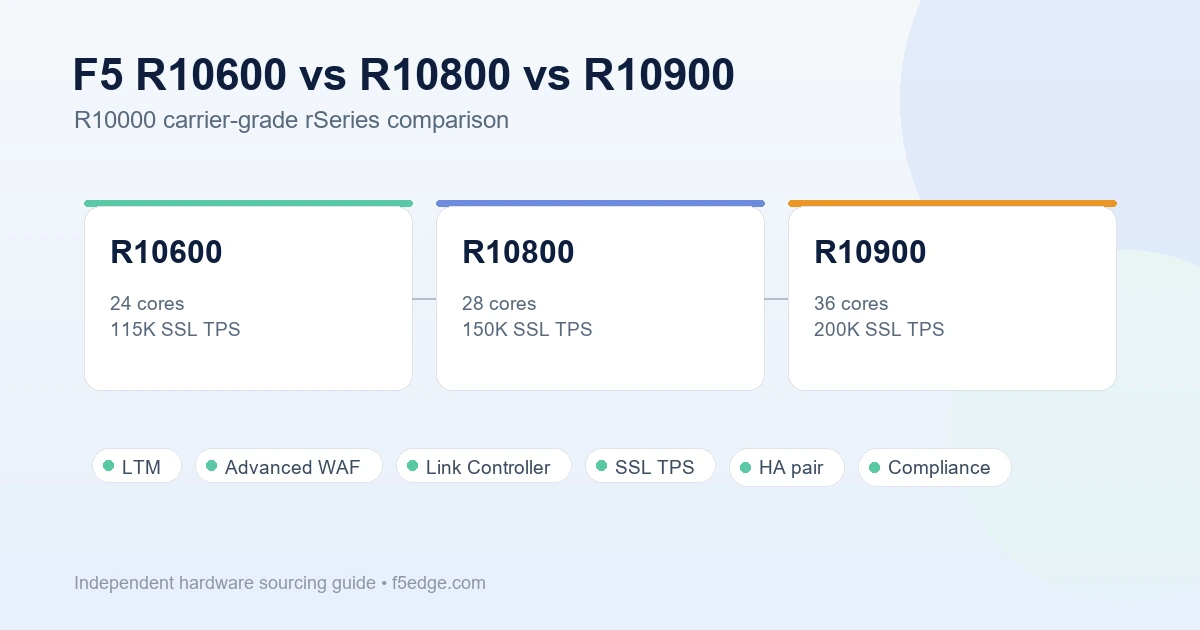
Moving up the line, L7 throughput closes the gap with L4 throughput and SSL processing capacity scales up sharply: the R10600 delivers 125 Gbps L7 throughput and 115,000 SSL TPS on 24 cores, the R10800 steps up to 145 Gbps L7 and 150,000 SSL TPS on 28 cores, and the R10900 is the top model with fully balanced 190 Gbps L4/L7 throughput and 200,000 SSL TPS on 36 cores. Choose based on how close your Layer 7 and SSL/TLS load is to your Layer 4 traffic volume, not on core count alone.
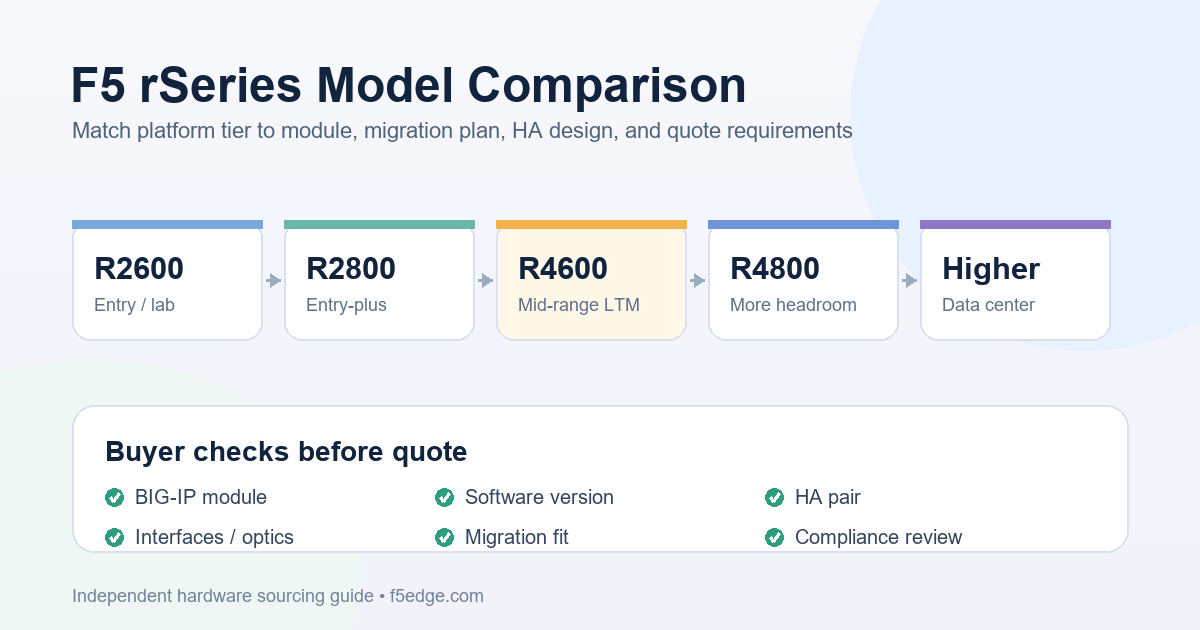
For the tier below this, review F5 R5900 vs R10600. For the tier above, see F5 R12600-DS vs R12800-DS vs R12900-DS. For the full lineup, start with the F5 rSeries model comparison guide.
R10600 vs R10800 vs R10900 Comparison Table
| Decision Area | F5 R10600 | F5 R10800 | F5 R10900 | Buyer Takeaway |
|---|---|---|---|---|
| Platform role | Entry point into the R10000 carrier-grade class | Mid-tier R10000 model with narrowing L4/L7 gap | Top R10000 model, fully balanced L4/L7 | All three ship as single-module (LTM/AWF/LC) or Best Bundle hardware |
| Business processing cores | 24 cores | 28 cores | 36 cores | Core count tracks directly with L7 and vCMP capacity |
| L4 / L7 throughput | 190 Gbps / 125 Gbps | 190 Gbps / 145 Gbps | 190 Gbps / 190 Gbps | L4 throughput is shared; L7 headroom is the real differentiator |
| SSL TPS (2K keys) | 115,000 | 150,000 | 200,000 | SSL/TLS-heavy deployments should size on this line, not L4 throughput |
| Max L4 concurrent connections | 145M | 160M | 180M | Connection ceiling scales with core count up the tier |
| Memory | 256 GB DDR4 | 256 GB DDR4 | 256 GB DDR4 | Memory is shared across the tier; density gains come from cores and SSL capacity |
| Network I/O | 4x 100G/40G QSFP+, 16x 25G/10G SFP+ | 4x 100G/40G QSFP+, 16x 25G/10G SFP+ | 4x 100G/40G QSFP+, 16x 25G/10G SFP+ | Port layout is identical; plan optics and cabling the same way for any of the three |
| Reliability | Dual PSU, RAID1 dual drives | Dual PSU, RAID1 dual drives | Dual PSU, RAID1 dual drives | Carrier-grade redundancy is standard across the tier |
| Typical use | Carrier-grade entry, L4-heavy or moderate L7 workloads | Mixed L4/L7 workloads with growing SSL/TLS inspection needs | Application-layer-heavy, high-SSL, or top-density vCMP consolidation | Confirm exact throughput and SSL TPS figures for your target model directly with the supplier, since published specs can vary by firmware and configuration |
When the F5 R10600 May Fit
The R10600 is the practical entry point into the R10000 carrier-grade class. It fits projects that have clearly outgrown high-density rSeries models like the R5900 but do not need the highest Layer 7 or SSL processing capacity in the R10000 line.
R10600 may fit when:
- Layer 4 throughput and connection scale matter more than pushing Layer 7 traffic close to the same ceiling.
- SSL/TLS load is significant but not at the top end — 115,000 SSL TPS covers most large enterprise workloads.
- 24 business-processing cores comfortably cover current LTM, Advanced WAF, or Link Controller sizing with reasonable growth room.
- The buyer wants R10000-class reliability (dual PSU, RAID1, 145M concurrent connections) without paying for headroom that will not be used.
When the F5 R10800 May Fit
The R10800 sits in the middle of the tier and is a practical choice when Layer 7 processing and SSL/TLS inspection are growing faster than raw Layer 4 volume.
R10800 may fit when:
- The application mix is shifting toward more encrypted traffic, more complex iRules, or heavier WAF policy sets that need more than 24 cores to process without added latency.
- 150,000 SSL TPS and 160M concurrent connections give enough margin for near-term growth without moving to the top model.
- The project is standardizing on the R10000 tier but wants a documented buffer above the R10600 before the next hardware refresh cycle.
When the F5 R10900 May Fit
The R10900 is the top model in the R10000 line, the only one in the tier where Layer 7 throughput fully matches Layer 4 throughput at 190 Gbps.
R10900 may fit when:
- Application-layer processing — iRules, SSL offload, WAF inspection — is expected to run at or near full line rate alongside L4 traffic.
- SSL/TLS decryption and inspection volume is at the high end (200,000 TPS), such as zero-trust architectures or large financial data centers.
- The platform needs the highest vCMP tenant and business-processing density available before moving into the R12000-DS Best Bundle tier.
- Growth headroom matters more than minimizing initial hardware cost, and the buyer wants to avoid a near-term second upgrade.
Module-by-Module Considerations
For BIG-IP LTM, compare current and projected SSL/TLS ratio, connection behavior, iRules complexity, and health monitor count against the SSL TPS and concurrent connection figures above — the R10600/R10800/R10900 gap is driven almost entirely by SSL processing and core capacity, not L4 throughput.
For Advanced WAF, size by protected application count, policy complexity, and request volume rather than by model name. A moderate WAF estate can fit comfortably on the R10600; a large or fast-growing WAF deployment with heavy encrypted traffic is a stronger case for the R10800 or R10900.
For Link Controller, confirm link count, routing dependencies, and whether LTM or Advanced WAF will run on the same hardware — LC alone rarely requires moving up the R10000 tier, but LC combined with LTM and WAF changes the sizing math.
For Best Bundle or multi-module sourcing, verify exactly which modules are licensed on the unit being quoted and whether the license state matches the quote. At this tier, buyers moving toward the largest deployments should also review whether the R12000-DS Best Bundle series is a better long-term fit than staying at the top of the R10000 line.
Availability, Lead Time, and Configuration Checks
Confirm optics type and count against the 4x 100G/40G QSFP+ and 16x 25G/10G SFP+ port layout, power supply and rail kit requirements, exact module licensing, software version expectations, support status, and destination country before requesting a final quote. Because L4 throughput and port layout are identical across all three models, lead time and configuration availability — not raw specs — often end up deciding between adjacent models like the R10600 and R10800.
For product-specific details, review the F5 R10600 LTM page, the F5 R10800 LTM page, and the F5 R10900 LTM page.
Quote Information to Prepare
Before requesting a quote, prepare:
- Target model: R10600, R10800, R10900, or a comparison across two or more
- Required BIG-IP module (LTM, Advanced WAF, Link Controller, or Best Bundle)
- SSL/TLS traffic volume and expected growth, since this is the primary differentiator between the three models
- Current hardware model and BIG-IP software version if this is a replacement or consolidation project
- Traffic profile, application count, and expected growth over the platform’s service life
- Interface, optics, power, rail, and accessory requirements matched to the 100G/25G port layout
- Quantity, destination country, delivery deadline, and preferred condition
- Export control or trade compliance documentation needs
Use the same details in the F5 BIG-IP hardware quote checklist so supplier responses can be compared consistently.
Compliance Note
F5, BIG-IP, rSeries, iSeries, LTM, Advanced WAF, Link Controller, and related product names are trademarks of their respective owners. F5edge.com provides independent hardware sourcing support and does not claim to be an official or authorized F5 reseller. Quote requests are subject to export control and trade compliance review. We do not process requests involving restricted destinations, prohibited parties, or prohibited end uses.
FAQ
What is the difference between F5 R10600, R10800, and R10900?
The clearest differences are Layer 7 throughput, SSL TPS, and core count: 125 Gbps L7 / 115,000 SSL TPS / 24 cores on the R10600, 145 Gbps L7 / 150,000 SSL TPS / 28 cores on the R10800, and fully balanced 190 Gbps L4/L7 / 200,000 SSL TPS / 36 cores on the R10900. Memory, L4 throughput, and port layout are shared across all three.
Can I buy an R10000 model as LTM-only or Advanced WAF-only hardware?
Yes. Unlike the R12000-DS series above it, the R10600, R10800, and R10900 are each available as independent single-module hardware (LTM, Advanced WAF, Link Controller) as well as Best Bundle configurations.
When should I move from R10600 or R10800 up to R10900?
Consider the R10900 when Layer 7 application processing, SSL/TLS decryption, or vCMP tenant density needs to run at or near full line rate, or when the current model’s SSL TPS ceiling is becoming a real constraint rather than a theoretical one.
When should I move from R10900 to the R12000-DS series?
Consider the move when the deployment needs more vCMP tenant density or service-processing core capacity than the R10000 tier provides, or when the project is consolidating a larger number of business units, customers, or environments onto one platform. See the R12600-DS vs R12800-DS vs R12900-DS comparison for details.